Urban regeneration schemes succeed or fail on the details as much as the masterplan. While architecture and infrastructure set the framework for a public space, it is street furniture that determines whether people actually want to use it. Benches, bollards, planters, litter bins and cycle stands are often treated as afterthoughts in the design process, yet they shape how safe, comfortable and welcoming a place feels in practice. As town centres, transport hubs and neighbourhoods across the UK and beyond undergo renewal, the specification of street furniture has become a central consideration for architects, landscape architects and local authorities. This article examines how street furniture supports placemaking objectives, reviews notable regeneration case studies, and explores the materials, accessibility standards and digital technologies shaping the next generation of public realm design.
Defining street furniture within placemaking frameworks
Street furniture refers to the objects and facilities installed in public spaces to support the people who use them, ranging from seating and lighting to bollards, litter bins and bicycle racks. Historically, urban spaces were designed around buildings and roads, with people expected to adapt to the infrastructure around them. That approach has shifted significantly over the past two decades, with planners increasingly designing places around community needs rather than the reverse.
This shift owes much to the placemaking movement, championed by organisations such as the Project for Public Spaces, which promotes community-led design as a way of strengthening the connection between people and the places they share. Within this framework, street furniture is no longer simply functional; it is a tool for expressing local identity, encouraging social interaction and building community pride. Well-chosen furniture can turn an unremarkable junction or square into a destination, while poorly considered furniture can undermine an otherwise strong scheme.
Bollards, bollard lighting and pedestrian delineation systems
Bollards perform a quietly important role in regeneration projects. Beyond restricting vehicle access and protecting pedestrians, they help define the edges of shared spaces, guiding movement without the need for heavy-handed barriers or signage. When integrated with lighting, bollards also contribute to the ambience and perceived safety of a space after dark, helping people feel more comfortable using it into the evening. Thoughtfully placed bollards therefore serve a dual purpose: they provide security while contributing positively to the character of the surrounding streetscape.
Public seating typologies: from camden benches to modular units
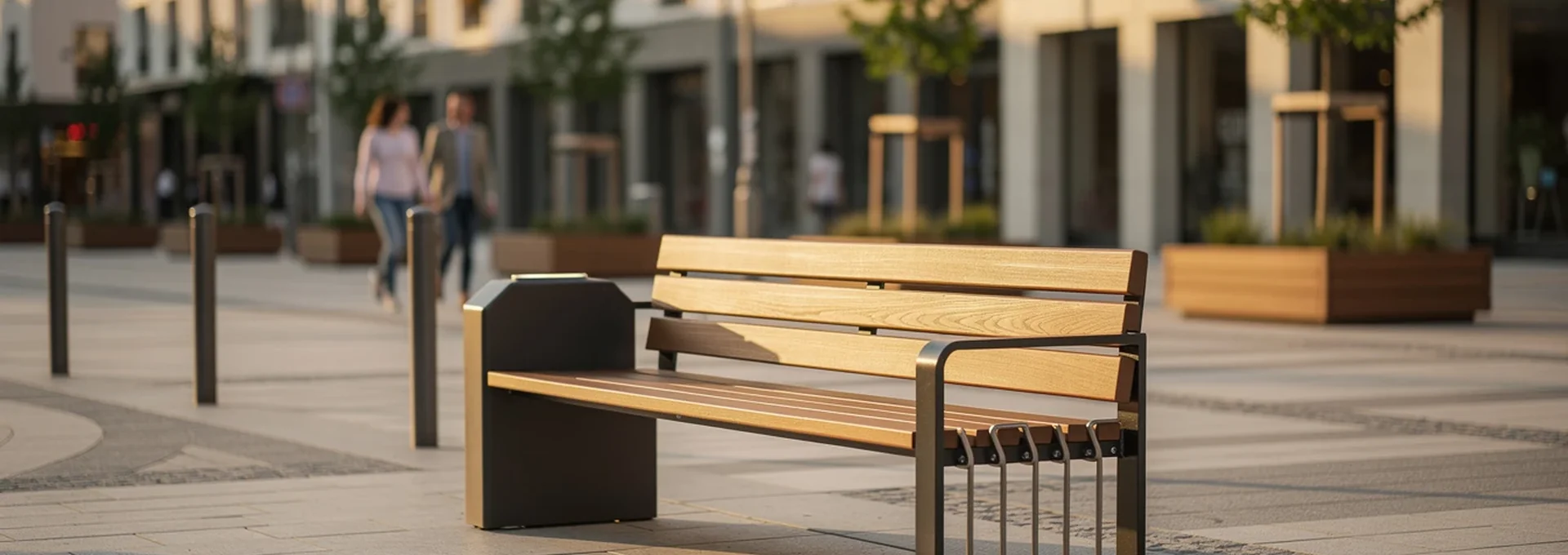
Seating remains one of the most important elements of any public realm scheme. When people have somewhere comfortable to sit, they linger longer, and that dwell time translates into greater social interaction and community bonding. Seating solutions now span a wide range of typologies, from robust, anti-vandal designs suited to high-footfall city centres, through to modular units that can be reconfigured for events or changing pedestrian flows. Materials vary considerably too, with timber, steel, recycled composites and contemporary architectural finishes all specified depending on context, durability requirements and the desired aesthetic. The common thread across successful seating design is that it must serve multiple functions: rest, gathering, informal meetings and, increasingly, sheltered waiting alongside transport infrastructure.
Bicycle racks, sheffield stands and Micro-Mobility infrastructure
As alternative transport modes gain prominence, secure and well-placed cycle parking has become a standard requirement in regeneration schemes. Bicycle racks and bike-sharing stations reduce reliance on cars and support a greener approach to commuting and leisure travel. Properly sited cycle parking also extends the accessibility of parks, high streets and civic spaces to a wider range of users, encouraging both adults and children to choose active travel over private vehicles. Investment in this infrastructure is widely regarded as one of the more cost-effective ways for a city to reduce traffic congestion and improve public health outcomes.
Litter bins, recycling units and waste management design
Waste management infrastructure is easy to overlook, yet strategically placed litter and recycling bins are essential to keeping regenerated spaces clean and inviting over the long term. Bins encourage responsible disposal habits, reduce litter, and support broader sustainability initiatives by making recycling straightforward for the public. Beyond pure function, the design of bins matters too: aesthetically considered units help maintain visual consistency across a site and reinforce the sense that a space is cared for, which in turn encourages users to treat it respectfully.
Case studies in urban regeneration schemes
Examining real-world regeneration projects shows how street furniture decisions translate placemaking theory into everyday use. The following schemes illustrate different approaches to integrating furniture, materials and shared space design.
Exhibition road, london: shared surface design by dixon jones
Exhibition Road in South Kensington is frequently cited as a landmark example of shared surface design, where the distinction between carriageway and pavement is deliberately blurred to prioritise pedestrian movement. The scheme relies on carefully positioned bollards, lighting and surface treatments rather than conventional kerbs to manage traffic and delineate space, demonstrating how street furniture can replace, rather than simply supplement, traditional highway infrastructure.
The high line, new york city: adaptive reuse and custom furniture
The High Line transformed a disused elevated railway into a linear public park, with custom-designed seating, planting and lighting integrated along its length. The project illustrates how bespoke street furniture, designed specifically for a site’s unique geometry and history, can support adaptive reuse and create a distinctive visitor experience that generic, off-the-shelf products could not achieve.
Nottingham’s market square redevelopment
Civic square redevelopments such as Nottingham’s Market Square illustrate how seating, planting and flexible paving can transform a historic public space into a venue capable of hosting markets, events and everyday civic life, while retaining its role as a functional through-route for pedestrians.
Barcelona’s superblocks (superilles) programme
Barcelona’s Superblocks programme reorganises groups of city blocks to restrict through-traffic and reclaim street space for pedestrians, cyclists and community use. Street furniture, including seating, planters and play elements, is central to reinforcing these reclaimed spaces as places for residents to gather rather than simply corridors for vehicle movement.
Materiality and durability in public realm design
The materials specified for street furniture directly affect its lifespan, maintenance costs and visual compatibility with the surrounding context. Getting this right is particularly important in regeneration schemes, where furniture must often withstand heavy public use for many years without significant degradation.
Corten steel versus cast iron in heritage contexts
In heritage and historic settings, the choice between weathering steel finishes and traditional cast iron often comes down to balancing contemporary durability with visual sympathy for older streetscapes. Cast iron has long associations with Victorian and Georgian civic design, while weathering steel finishes offer a more contemporary, low-maintenance alternative that can still complement historic surroundings when specified thoughtfully.
Timber specifications and FSC-Certified sourcing
Timber remains a popular choice for seating and picnic furniture thanks to its warmth and natural appearance, particularly in parks and green spaces. Responsible sourcing, including certification schemes that verify sustainable forestry practices, is an increasingly important consideration for specifiers seeking to align material choices with wider environmental commitments.
Anti-vandalism coatings and Powder-Coated finishes
Public realm furniture must withstand not only weather but also heavy use and occasional misuse. Powder-coated finishes and anti-vandalism treatments help protect steel and other metal components from corrosion and graffiti, extending service life and reducing the frequency of costly replacement or repair works.
Inclusive design and accessibility standards
Accessibility should be a fundamental consideration in every public realm project, not an added extra. Inclusive street furniture design ensures that outdoor environments can be comfortably used by people of all ages and abilities, supporting greater community participation.
BS 8300 compliance in street furniture specification
Compliance with relevant accessibility standards helps ensure that seating, bins and other furniture are positioned and dimensioned to support wheelchair users and people with mobility impairments. Considerations include clear approach widths, appropriate seat heights and the avoidance of trip hazards, all of which contribute to genuinely inclusive pedestrian routes.
Tactile paving integration with seating and signage
Coordinating tactile paving with the placement of seating, signage and other furniture helps people with visual impairments navigate public spaces safely and confidently. This kind of integrated thinking, rather than treating each element in isolation, is a hallmark of well-executed inclusive design.
Dementia-friendly design principles in public spaces
Age-friendly design extends beyond physical accessibility to consider cognitive needs, such as clear sightlines, legible signage and consistent, recognisable furniture styles that support orientation and reduce confusion for people living with dementia. Providing frequent, well-placed rest points is particularly valuable for older users and those with reduced mobility.
Smart street furniture and digital integration
As urban environments become more connected, street furniture is increasingly expected to offer digital services alongside its traditional physical functions. This trend is transforming what were once purely functional objects into multi-purpose infrastructure.
Solar-powered lighting bollards and IoT sensors
Smart lighting can now detect movement and adjust brightness accordingly, benefiting people with vision impairments while also reducing energy consumption. Solar-powered bollards and sensor-equipped fittings reduce reliance on grid electricity and can feed data back into wider monitoring systems, helping local authorities understand how spaces are used.
Interactive wayfinding totems and digital kiosks
Digital wayfinding installations help visitors navigate complex sites such as transport hubs, campuses and town centres, supplementing traditional signage with real-time, interactive information.
Usb-enabled benches: the strawberry energy model
Smart benches now provide features such as Wi-Fi access and device charging points, adding genuine everyday utility to a traditionally passive piece of furniture. One notable example of adaptability came in the London borough of Islington, where smart benches were reconfigured for World Cancer Day to allow users to make contactless donations of two pounds to Cancer Research UK, demonstrating how digital street furniture can support local causes and initiatives as well as everyday convenience.
Economic and social impact metrics of street furniture investment
Investment in street furniture is not merely cosmetic; it has measurable effects on how people use, and businesses benefit from, regenerated spaces. Well-designed public spaces equipped with functional, attractive furniture tend to attract both residents and visitors, creating opportunities for local businesses and stimulating economic activity. People are simply more likely to spend time, and money, in areas that feel comfortable and well cared for.
Footfall analysis pre- and Post-Regeneration in business improvement districts
Local authorities and Business Improvement Districts often track footfall before and after regeneration works to assess the impact of public realm improvements. While specific figures vary by scheme, the underlying logic is consistent: spaces that offer comfortable seating, effective waste management and safe, well-lit environments encourage longer visits and repeat use, which in turn supports adjacent retail and hospitality businesses.
Community consultation methodologies: participatory design workshops
Successful regeneration schemes increasingly involve the communities who will use the finished space from the outset. Participatory design workshops allow residents to voice their priorities, whether that means safer routes, more seating, better lighting or specific cultural references within the furniture design itself. This collaborative approach, central to the placemaking movement, helps ensure that street furniture reflects genuine local need rather than a generic, one-size-fits-all specification, and it strengthens the sense of ownership residents feel towards their public spaces once the works are complete.